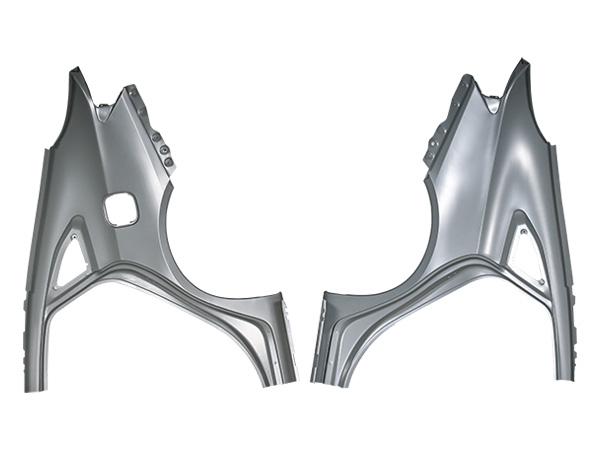
Springback in stamped parts is a pervasive challenge in precision stamping, particularly when using lightweight, high-strength materials such as high-strength steel and aluminum alloys. Springback causes dimensional deviations that directly impact assembly accuracy and product performance; consequently, a systematic solution requires multidimensional, coordinated optimization rather than a single approach.
Predicting springback and optimizing the part structure during the process design phase are central to controlling the issue at its source. Stamping simulation technology is employed to model the material's elastic deformation, plastic deformation, and unloading springback trends. A common and effective solution involves "reverse surface compensation," where pre-deformation—opposite in direction to the anticipated springback—is incorporated into the working surfaces of the punch or die to counteract the elastic recovery that occurs upon unloading. Simultaneously, optimizing the part's structure—such as by adding local stiffening ribs, reducing free-bending zones, and refining corner transitions—enhances overall rigidity and limits the scope for elastic deformation, thereby structurally reducing the magnitude of springback.
Refining the die structure is a critical step in controlling springback. The clearance between the punch and die must be tailored to the material type and thickness; excessive clearance leads to insufficient compression and inadequate plastic deformation, while insufficient clearance causes material thinning or even cracking. Typically, the unilateral clearance is set at 0.9 to 0.95 times the material thickness, utilizing slight coining to enhance plastic deformation and minimize elastic recovery. Optimizing the blank-holding mechanism is equally important; using rigid blank holders or devices with adjustable back-pressure ensures the material is securely clamped during bending, thereby limiting warping and elastic springback. For hard-to-form materials like high-strength steel, increasing the blank-holding force can effectively reduce springback. Furthermore, the punch corner radius must be matched to material properties; an excessively large radius reduces the degree of plastic deformation at the bend, while a radius that is too small causes stress concentration and cracking. A radius of 5 to 10 times the material thickness is generally selected to balance sufficient deformation with forming quality.
Matching material selection with process parameters serves as a supplementary measure. Materials with a low yield-to-tensile ratio and good plasticity are preferred; the yield-to-tensile ratio reflects the proportion of elastic deformation to plastic deformation—the lower the ratio, the less elastic recovery occurs upon unloading, making springback easier to control. If high-strength materials are used, internal stresses can be relieved and plasticity improved through pretreatment methods such as annealing. Regarding process parameters, multi-stage bending can replace single-step forming; for large bent parts, the process is split into pre-bending and finish-bending stages to distribute the deformation load and reduce the amount of springback generated in any single step. Additionally, stamping speeds can be lowered to allow sufficient time for plastic deformation, thereby minimizing the proportion of elastic deformation associated with high-speed stamping and reducing springback. For parts requiring high precision, a subsequent correction step is added: applying reverse pressure to the area prone to springback induces reverse plastic deformation that counteracts the initial springback—a technique widely used in the manufacture of critical components for the aerospace and automotive industries.
Since springback characteristics vary among different parts, the aforementioned methods should be selected and combined based on factors such as part geometry, precision requirements, and production volume. For instance, small-batch trial production focuses on correction steps and die clearance adjustments, whereas high-volume, high-precision production relies on simulation-based compensation and refined die design. Through comprehensive process control, springback issues in stamped parts can be effectively and consistently resolved.



 WhatsApp
 Phone
Phone Email
Email Message
Comment
(0)