As the automotive industry moves toward energy conservation, emission reduction, and electrification, vehicle lightweighting has become a key strategy for improving fuel economy and extending driving range. Statistics indicate that a 10% reduction in vehicle weight can lower fuel consumption by 6% to 8%; specifically, every 100-kilogram reduction saves approximately 0.2 to 0.3 liters of fuel per 100 kilometers. Given that sheet metal components account for a significant portion of a vehicle's total mass, reducing their weight has become a focal point for both manufacturing and R&D teams. This article systematically outlines the design logic for lightweighting sheet metal components across four dimensions: material substitution, structural optimization, process innovation, and joining integration.
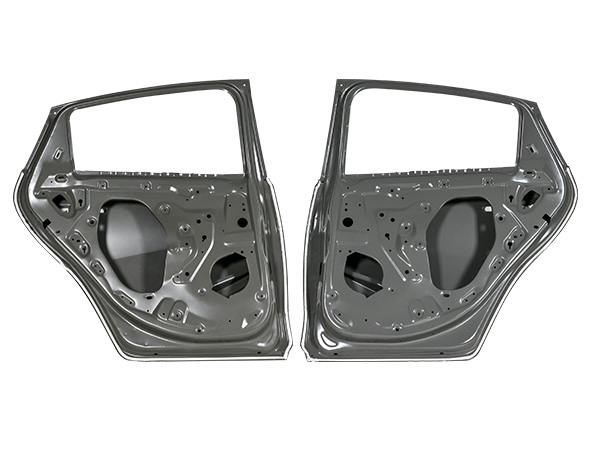
I. Material Selection: Achieving "Weight Reduction Without Compromising Performance" via Low Density and High Strength
The most direct method for reducing the weight of sheet metal components is to select materials with low density or high specific strength. Conventional low-carbon steel has a density of approximately 7.85 g/cm³, whereas aluminum alloy is only about 2.7 g/cm³—roughly one-third that of steel—allowing for a weight reduction of about two-thirds for the same volume. Magnesium alloy is even lighter, with a density of approximately 1.74 g/cm³—about one-third lighter than aluminum. Using aluminum alloy for body panels, such as hoods and fenders, can reduce weight by approximately 40% compared to steel.
On the other hand, high-strength steel enables indirect weight reduction through a "thin-for-thick" approach. Hot-formed boron steel boasts a tensile strength exceeding 1,500 MPa; reducing its thickness from 1.5 mm to 0.8 mm can achieve a weight reduction of nearly 47%. Advanced high-strength steels—such as dual-phase (DP) steel and transformation-induced plasticity (TRIP) steel—allow for reduced material thickness in crash-energy-absorbing zones while still meeting safety standards. A graded material strategy—using high-strength steel in high-stress areas and easily formable aluminum or low-carbon steel in low-stress areas—creates an optimal balance between performance and cost.
II. Structural Design: Topology Optimization and Thin-Walled Structures to Eliminate Redundant Mass
The core principle of lightweight design is the distribution of material based on actual requirements. Topology optimization utilizes finite element analysis to simulate loads and remove material from areas that contribute little to structural strength, resulting in hollowed-out designs or rib-reinforced structures. For instance, topology optimization allows for the removal of non-load-bearing material from the front longitudinal beam while reinforcing critical load-bearing zones.
Specific measures include:
Ribs and bosses: Adding stiffening ribs to flat, non-critical panels suppresses vibration and avoids the need for overall thickening.
Thin-walling: Using thin-gauge stamping for outer door panels maintains strength despite reduced wall thickness.
Integration: Consolidating multiple discrete parts into a single stamped module reduces the mass associated with overlapping connection points.
Weight-reduction holes: Creating apertures in low-stress zones—while avoiding bent sections and edges—reduces weight.
Variable cross-sections and tailored blanks: Laser-welded tailored blanks join materials of different thicknesses; applying this to seat cross-beams reduced weight by 1.142 kg (20.5%) and increased material utilization from 65% to 75%.
Shape optimization also plays a vital role; curved hoods require less material and offer lower drag than flat ones. Enlarging corner radii improves material flow, while flanging enhances edge stiffness.
III. Manufacturing Processes: Precision Forming Enables Thin-Walled Safety
Advanced manufacturing processes make the use of lightweight materials and thin-walled structures feasible. Hot stamping involves austenitizing steel sheets followed by simultaneous quenching and forming to produce uniform martensite, resulting in strengths exceeding 1,500 MPa and minimal springback. Hydroforming uses fluid pressure to reduce weld seams and increase the stiffness of hollow components; for example, a hollow aluminum Subframe is 50% lighter than a solid steel counterpart. Laser tailored welding, roll forming, and laser cutting ensure high precision and reduce material overlap.
CNC stamping and multi-station dies maintain micron-level accuracy, while temperature control in hot-forming dies minimizes dimensional deviation. CAE forming simulations predict thinning and potential crack initiation sites. These processes turn the concept of "replacing weight with strength" into reality.
IV. Joining and Surface Treatment: Multi-material Synergy and Durability
Steel-aluminum hybrid bodies require techniques such as self-piercing riveting, friction stir welding, and adhesive bonding to prevent hot cracking and galvanic corrosion between dissimilar materials. Structural adhesives enhance overall stiffness, allowing for thinner inner panels without compromising reliability. Surface treatments—such as galvanizing and e-coating—provide 1,000-hour salt spray resistance, while cavity wax injection prevents crevice corrosion, ensuring the long-term durability of lightweight components. Due to the added weight of batteries, new energy vehicles rely increasingly on aluminum alloys and high-strength steels, utilizing self-piercing riveting for joining and conversion coatings for corrosion protection. The characteristics of material joining determine the feasibility of achieving lightweighting at the vehicle level.
V. Synergistic Constraints and Future Trends
Weight reduction should not be pursued merely for the sake of lightness. A loss in rigidity that degrades NVH performance requires compensation via structural ribbing, while weight reduction in energy-absorption zones necessitates controllable deformation. Multi-objective optimization must simultaneously account for strength, weight, and modal characteristics.
Emerging trends feature the evolution of third-generation high-strength steels, aluminum-lithium alloys, hot-forming/hydroforming hybrid processes, and 3D-printed tooling. Intelligent stamping with real-time parameter adjustment reduces scrap rates, while eco-friendly servo presses lower energy consumption.
In summary, reducing the weight of automotive sheet metal components relies on an integrated approach combining material substitution, topology-optimized thin-wall structures, precision manufacturing processes, and multi-material joining techniques. Understanding these pathways helps capture the benefits of lightweighting technology and drives advancements in overall vehicle energy efficiency.



 WhatsApp
 Phone
Phone Email
Email Message
Comment
(0)